Exploring new horizons: LegumeLegacy doctoral researchers on secondments

Exploring new horizons: LegumeLegacy doctoral researchers on secondments
Spending time at another research institute provides an opportunity to learn, grow, and experience a different culture of science. Earlier this year, several of the doctoral researchers in LegumeLegacy took part in international research stays as part of their PhD journey. Among them, Julian Nyaga spent time at Agriculture and Agri-Food Canada in Quebec, while Ellen Baekelmans completed her stay at Teagasc in Ireland. These secondments are part of the project’s broader interdisciplinary training, giving each researcher the opportunity not only to deepen their skills in modelling and soil biodiversity analyses, but also to experience diverse environments, from a Canadian winter to an Irish spring. The stays proved both academically enriching and personally memorable, with more secondments planned across the consortium in the coming months.
At the end of December 2024, I travelled to Quebec, Canada for a research stay at Agriculture and Agri-Food Canada (AAFC). I was excited to welcome the new year (my first days of 2025) in Quebec. Upon landing, I was warmly received by Emmanuelle from AAFC, and we had a scenic drive to my residence while exchanging essential information and enjoying the winter landscape.
As it turned out, I spent my New Year’s Eve indoors, experiencing my first snowfall. I was thrilled to be in Canada but unprepared for how truly cold it could get. I hadn’t fully imagined what -25°C would feel like! Luckily, an underground tunnel connected my residence to the AAFC building, which meant I could avoid the freezing weather and even walk to the office in a T-shirt.
My research stay focused on understanding nutrient (nitrogen, phosphorus, and carbon) leaching and how it is influenced by crop type, fertilization, and the termination of leys. I began by learning to model drainage in the soil using the STICS model, which was new to me. With expert guidance from Guillaume, a modelling scientist at AAFC, I quickly got up to speed and achieved significant milestones in simulating drainage processes.
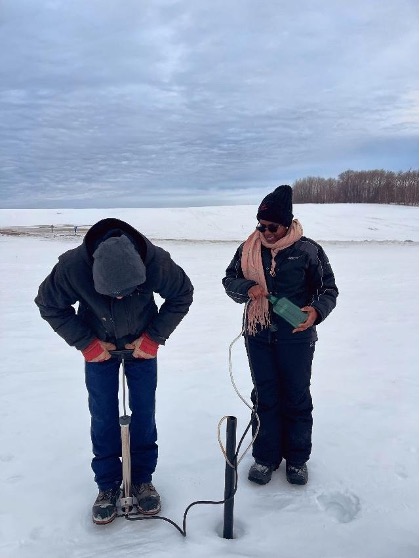
I also had the unique experience of collecting leachate samples outdoors in winter, a chance to see how soil processes continue beneath the snow. Beyond modelling, I got to see AAFC’s laboratory work up close, learning how various machines are used to analyze the leachates.
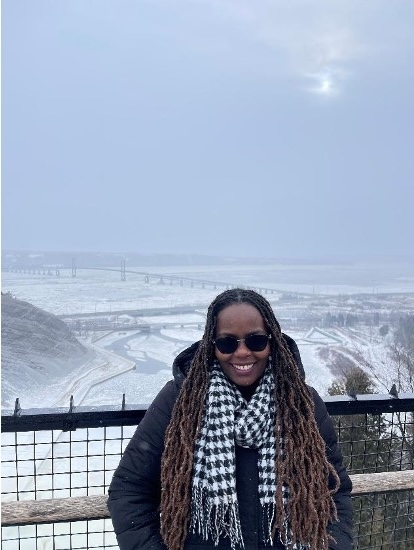
Outside work, I enjoyed exploring Quebec’s winter beauty. I visited Old Quebec Town and learned about its history, admired the frozen Saint Lawrence River and Montmorency Falls, and explored the stunning Parc National de la Jacques-Cartier for winter activities. I also got to taste local treats like maple syrup and poutine (a Quebec delicacy) and experienced local festivals, making my stay memorable both academically and culturally.
For my interdisciplinary secondment, I had the opportunity to spend a period at Teagasc Johnstown Castle in the sunny southeast of Ireland (Wexford) this spring. The focus of this secondment was understanding and applying the Diversity-Interactions (DI) models on the data of the field experiment in the Netherlands. Our experiments are set up in such a way that we can use the DI models to analyse the data to study how ecosystem functions are affected by – simultaneously – looking at the number of grassland species, the proportions of the species and the identity of the species in the swards (DI Models). Due to the excellent supervision of Dr. John Finn and help from others, I am now able to analyse my data in a more independent manner. And guess what?! Modelling can be fun!
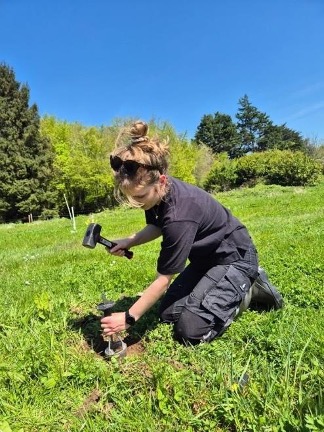
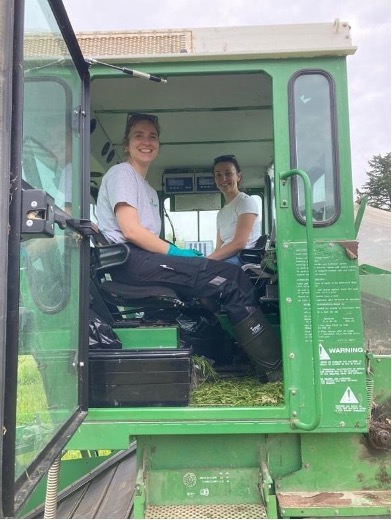
Beside modelling work, I also had the opportunity to get field and lab experience. I had my first experience with a plot harvester. I helped collect grassland samples for species sorting and forage quality analysis. I also participated in soil bulk density measurements, and helped in the lab with microbial biomass extractions.
I also attended a workshop bringing together Irish PhD students and supervisors at the UCD Lyons farm, where I could network with people in the same field as me and enhance collaboration. I introduced myself and my work, and I learned about their preliminary results. They showcased their experimental fields and their feeding experiment with sheep.
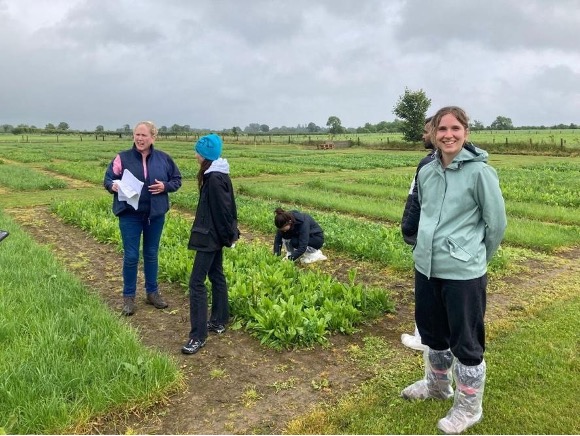
Furthermore, we organised a workshop at Teagasc with the PhD students from LegumeLegacy who are based in Ireland doing a PhD in statistics. We presented our work and preliminary results, and were shown different (feeding) experiments related to multispecies swards and greenhouse gas emissions.
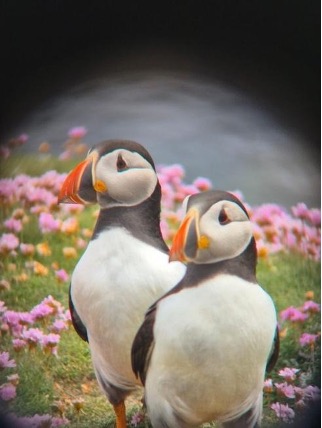
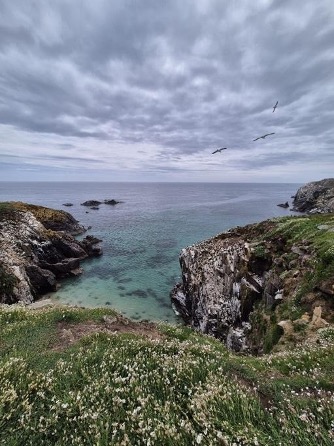
Finally, I used the weekends to go sightseeing – and most of the time, I was very lucky with the weather. One of my personal highlights was a visit to the Saltee Islands, where puffins breed during spring and summer.
In general, I look back on my secondment as a very positive experience, where I had the chance to strengthen my analytical skills, gain insights into the practices of another research institute, network with other researchers, and discover some beautiful places in Ireland.
This blog post was written by Ellen Baekelmans and Julian Nyaga and edited by Emery Wang and Raniel Valencia.